You model the fields of your form with elements, through which the user works on the form. You can choose between many different sorts of elements such as text and password fields, a calendar, lists, and attachments.
Below you'll see how to set up a TEXTBOX form element to serve as an example. Other elements are incorporated in exactly the same manner. A complete description of form elements and their properties can be found in the chapters Form elements and Form elements.
To add a new form element, click in a column field of the form editor on the symbol  . The cursor context menu displays Add new element. Choose it to open the element type form window.
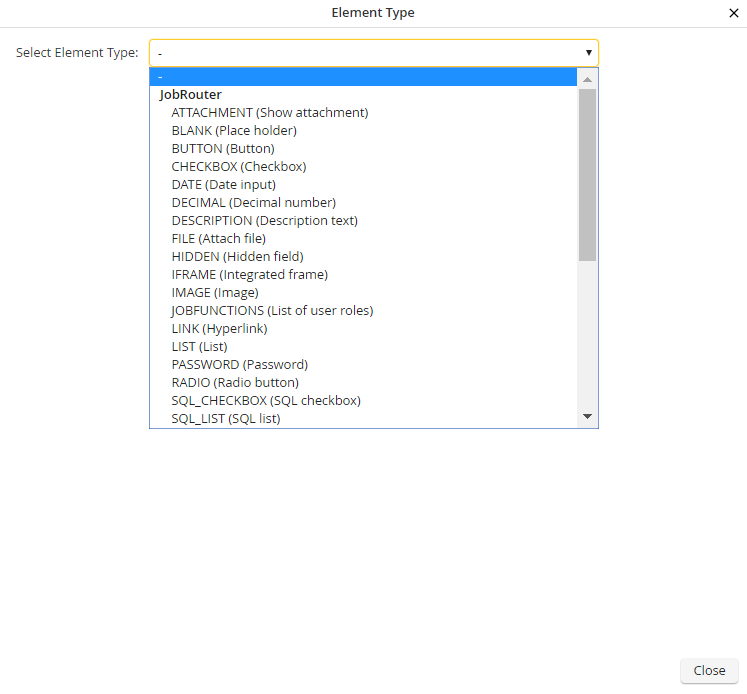
Choose element type
You have a choice of the following default Element types.
Element type |
Description |
|---|---|
ATTACHMENT |
Display attachment |
BLANK |
Place holder |
BUTTON |
Button |
CHECKBOX |
Checkbox |
DATE |
Date field |
DECIMAL |
Decimal number (123.00) |
DESCRIPTION |
Description text |
FILE |
Attaching a file |
HIDDEN |
Hidden field |
IFRAME |
Integrated frame (only for desktop view) |
IMAGE |
Image |
JOBFUNCTIONS |
List of JobFunctions |
LINK |
Hyperlink |
LIST |
List |
PASSWORD |
Password |
RADIO |
Radio button |
SQL_CHECKBOX |
SQL-Checkbox |
SQL_LIST |
SQL lists |
SQL_TABLE |
SQL-table (only for desktop view) |
SQL_TEXTBOX |
SQL text input field |
SUBTABLE_VIEW |
Subtable view (only for desktop view) |
TEXT |
Text |
TEXTAREA |
Multi-line text input field |
TEXTBOX |
Text input field |
USERS |
User list |
Select an Element type and click Continue to access the element properties form window for the selected element type.
It will appear similar to the following, which is for a TEXTBOX element.
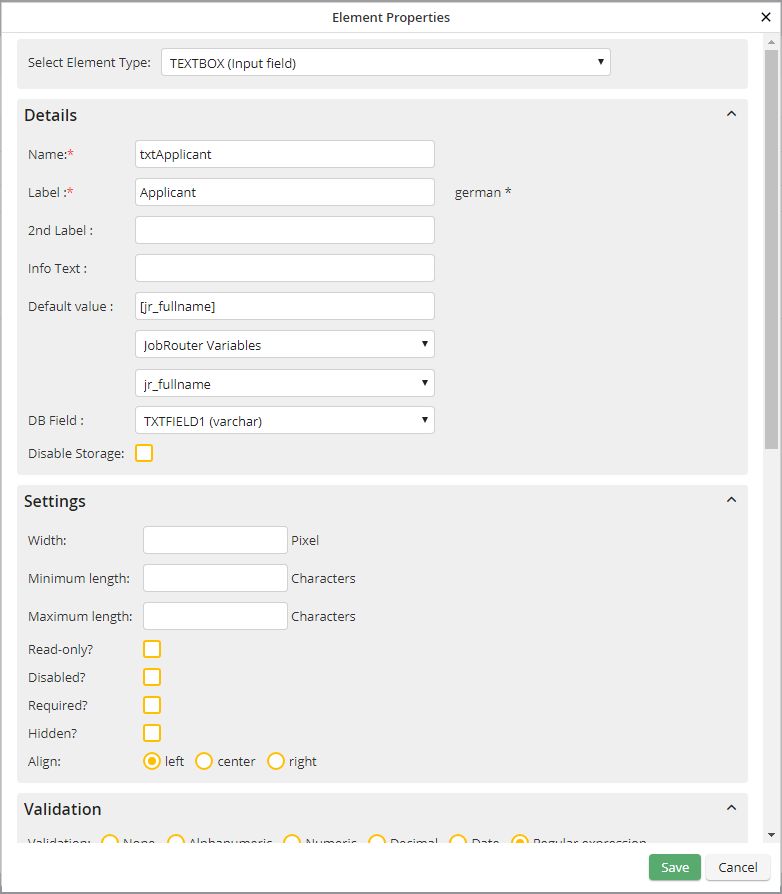
Element properties for TEXTBOX
You can specify the following properties.
Properties |
Description |
|---|---|
Name |
•Required •Assign a name for the field. •The following names are reserved and should not be used: version, processname, id, mode, groupname, backlink, form, tablename, processid, step, workflowid, do, key, ps, process, username, type and token |
Label |
•Required •Provide an appropriately descriptive label to the field. •The label will appear to the left of the text input field in the form. •If your process is multi-lingual, you can provide labels in multiple languages. Click in the input field to open additional input fields. |
Label-2 |
•The optional second label would appear after the text input field. •This field can likewise be entered in multiple languages. (see above). |
Balloon help text |
•This text is displayed in a help balloon when the mouse pointer passes over the element. •You can enter the text in multiple languages. |
Default value |
•You can pre-fill the input field with any text you wish. •Moreover, this text can come from form fields, DB fields, JobRouter variables, as well as from configurations. •If the text comes from a form field, you'll see an additional drop-down list containing the available form fields. |
DB field |
•You can use fields from the process table having type VARCHAR, INT, BIGINT and TEXT. |
Width |
•Specify the width of the input field, in pixels. |
Minimum length |
•Specify the minimum length of the input, in characters. |
Maximum length |
•Limit the input length to this number of characters. |
Write-protected |
•Specify whether the field should be write-protected. |
Deactivated |
•Use this function to disable the field. |
Required |
•Decide whether the user must fill in this field. |
Hidden |
•The field will not be displayed. |
Alignment |
•Specify whether the text of the input field should be left, center, or right justified. |
Validation |
•You can check the validity of the input value. For more information, see Validation of form elements. |
OnClick |
•Add scripts to be executed when the user clicks on the element. |
OnChange |
•Add scripts to be executed when the element's value changes. |
OnFocus |
•Add scripts to be executed when the cursor stops within the input field. |
OnBlur |
•Add scripts to be executed when the cursor leaves the element. |
OnKeyDown |
•Add scripts to be executed when characters are input. |
Caption color |
•Specify the color of the caption for the element. |
Background color |
•Specify the text background color of the element. |
Font color |
•Change the font color for the input field. |
For the properties label, 2nd label and the info text, process messages can be defined, which allows maintaining the translations in a central place. For more information See chapter Process messages as translation for form and subtable elements.
When you have finished your entries, click Save to store them and be taken back to the forms designer.
Or click Cancel to exit the form window without saving any entries and be taken back to the forms designer.
Clicking Back takes you back to the element type drop-down list.